Industrial enclosures must deliver uncompromising performance across three interdependent functions: structural integrity, EMI/RFI shielding, and thermal dissipation.
Professional OEM fabricators balance these demands holistically—not as isolated specs—but through integrated material selection, joint design, and process validation. This systems-level approach prevents trade-offs that compromise safety, uptime, or regulatory compliance.
Achieving ingress protection and safety certifications hinges on dimensional precision at critical interfaces. A ±0.005” tolerance is not arbitrary—it reflects the threshold required to maintain functional sealing and electrical continuity across demanding industrial standards:
| Feature | Tolerance Requirement | Compliance Impact |
|---|---|---|
| Door-Seam Alignment | <0.008" gap consistency | Enables IP66-rated dust and high-pressure water resistance |
| Fastener Hole Positions | ±0.003" dimensional accuracy | Ensures uniform gasket compression per UL 50E requirements |
| Flange Flatness | Under 0.01" across surface | Maintains NEMA 4X certification for frequent washdown cycles |
Even minor deviations erode performance: a 2023 contamination study in chemical processing facilities found that exceeding the 0.010” gap threshold increased contaminant infiltration risk by 89%. Rigorous metrology—traceable to NIST standards—and statistical process control (SPC) are essential to sustain compliance. Failure to do so carries real cost: unplanned downtime linked to noncompliant enclosures averages $740,000 annually per facility, per Ponemon Institute’s 2023 Industrial Systems Reliability Report.
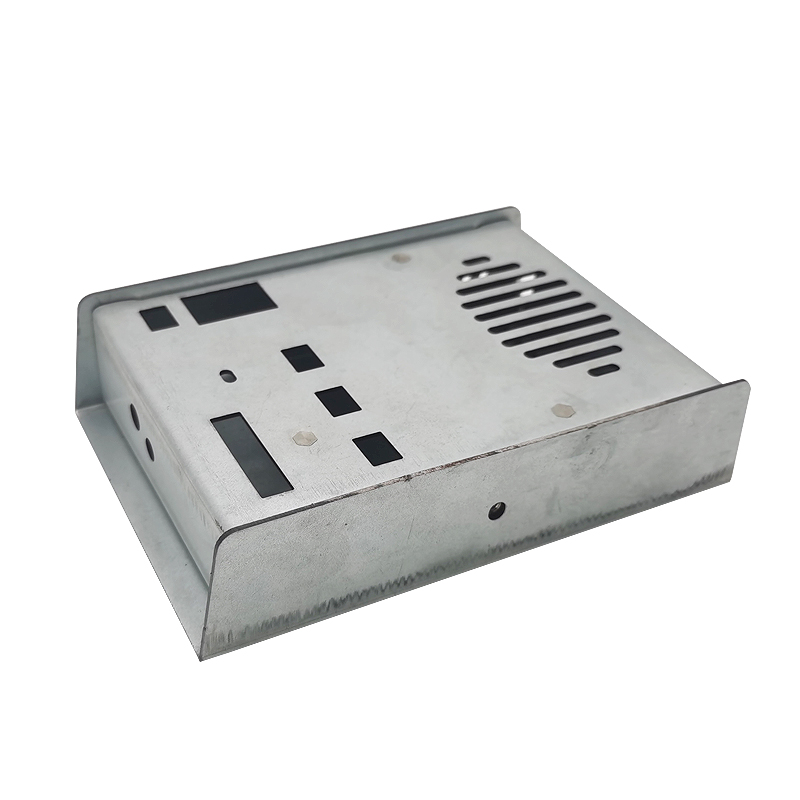
Material choice fundamentally shapes enclosure performance, manufacturability, and lifecycle cost. Stainless Steel 304 delivers high tensile strength, exceptional corrosion resistance, and superior impact resilience—making it the benchmark for exterior panels in NEMA 4X, IP66, and UL 50E-certified enclosures exposed to salt spray, caustic cleaners, or abrasive particulates. Aluminum 5052 offers a compelling alternative where weight, thermal conductivity, and complex geometry are priorities: its excellent bendability supports tight radii without cracking, reduces tool wear, and accelerates forming cycles. Its higher thermal conductivity also aids passive cooling in power-dense applications.
Smart designs often combine both—using 304 stainless for weather-facing components and 5052 aluminum for internal mounting structures or lightweight subassemblies. This hybrid strategy aligns material properties with functional requirements while optimizing total cost of ownership, including shipping, installation labor, and long-term maintenance.
Precision fabrication demands intentional process pairing—not just capability, but synergy.
Integrating these processes into synchronized production cells—such as laser-cut blank → robotic weld → automated finish—eliminates handling errors and reduces lead time. One HVAC OEM reduced setup time by 40% after integrating CNC punching with automated bending, demonstrating how strategic process alignment directly improves yield, scalability, and first-pass quality.
Regulatory compliance isn’t verified at final inspection—it’s engineered into every stage. IP66/IP67 ratings and NEMA 4X/UL 50E accreditation depend on consistent execution of precision-critical features: welded seam continuity, gasket seat flatness (<0.01”), and fastener hole positional accuracy (±0.003”). Even minor burrs or flange warpage—often introduced during punching or bending—can breach sealing surfaces or compromise EMI grounding paths.
Fabrication must conform to IPC-A-610’s acceptability criteria for sheet metal assemblies, including burr height limits, weld penetration standards, and post-processing finish integrity. For harsh-environment applications, corrosion resistance is validated per ASTM B117 salt-spray testing, and powder coatings must meet adhesion and UV stability benchmarks. Production facilities supporting these requirements hold ISO 9001:2015 certification and employ calibrated CMMs and vision systems to verify dimensions across environmental stress cycles—from -40°C to +85°C—ensuring dimensional stability under thermal expansion.
Crucially, UL 50E accreditation requires documented evidence—not just test results—of leak-path prevention (e.g., weld validation reports) and torque-controlled fastening protocols. Without auditable process controls and traceable metrology, certification remains aspirational, not assured.
DFM is most powerful when embedded early—not as a gatekeeping step, but as a collaborative engineering dialogue during initial concept review. Proactive DFM engagement identifies potential issues before metal is cut: interference between folded flanges and internal hardware, punch-and-bend sequence conflicts, or gasket compression inconsistencies caused by uneven flange flatness. One Tier-1 industrial OEM reduced prototyping iterations by 50% by incorporating DFM analysis into the quotation phase—ensuring first-run parts met both functional and assembly requirements out of the gate. This shifts development from reactive correction to predictive optimization, compressing time-to-market and lowering NRE costs.
Resilient OEM partnerships balance lean efficiency with supply chain redundancy. Leading manufacturers deploy just-in-time (JIT) delivery—tightly synchronized with customer build schedules—to minimize inventory overhead and obsolescence risk. Complementing JIT is dual-source buffering: pre-qualified secondary suppliers for critical raw materials (e.g., 304 stainless coil, 5052 sheet) and key subassemblies (e.g., welded chassis). This model doesn’t duplicate capacity—it validates alternate pathways before disruption occurs. Industry data shows programs using dual-source buffering experience 50% fewer production stoppages due to material shortages, according to the 2023 Global Supply Chain Resilience Index. The result is predictable delivery, stable pricing, and uninterrupted continuity for mission-critical equipment deployments.
Precision fabrication ensures compliance with industry standards like IP66, NEMA 4X, and UL 50E. It also guarantees functional sealing, structural integrity, and dimensional accuracy, leading to reliable performance under demanding conditions.
The primary materials are Stainless Steel 304, known for its corrosion resistance and tensile strength, and Aluminum 5052, valued for its lightweight and thermal conductivity properties. Often, these materials are used in combination for optimized performance.
DFM identifies design issues early in the product development phase, preventing costly revisions during production and ensuring that first-run parts meet assembly and functional requirements, which reduces time-to-market and prototyping iterations.
Key processes include laser cutting for accuracy, CNC punching for volume production, and robotic welding for consistent, high-quality seams. Combining these processes ensures efficiency and product reliability.
Regulatory compliance, such as IP66 and UL 50E standards, ensures the product performs reliably in harsh environments. It is achieved through stringent quality measures across all manufacturing stages.

 EN
EN